What a township supervisor’s special election tells us about how Democrats can make so much more progress in the hardest places.
One Saturday morning, I got a text from a number I didn’t recognize.
It was from a fellow named Ron Ruman. He introduced himself formally – name, district, who gave him my number – and then laid out his entire race in three paragraphs like he was writing a letter to a potential investor.
Which, I suppose, he was.
Ron is a township supervisor in Pennsylvania’s 196th state House district. The incumbent had resigned in January, triggering a special election. Before that, the seat had been uncontested since 2014. That’s twelve years without a Democrat on the ballot before Ron put his name in and ran during that special election.
He lost, 56 to 44.
That’s the number that would get written in the headline and reported broadly, probably alongside something like “lost by 12 points.” But there’s a lot that number doesn’t tell you.
He was outspent ten to one. Because he was running in an “unwinnable” race, he got no money from traditional Democratic funders. Even without resources, he had to endure the typical shenanigans – the county sent wrong mail-in ballots to 225 voters in his district. Then they failed to send requested mail-in ballots to 226 independents — which his campaign only found out because a supporter tipped them off.
Even so, Ron overperformed Kamala Harris in that district by 20.5 points.
He won the municipality where both he and his opponent live. He lost in the part of the district he simply couldn’t reach — because he didn’t have the money to get there. And he didn’t have the money to get there because nobody thought he could get close.
It’s another example of the vicious cycle that we see every election season, where we refuse to fund races in places where we can make incredible progress locally and make massive gains statewide because the numbers look dismal. But the numbers look dismal because we refuse to fund races in those same places.
As Ron said in his text to me:
“Money is not the only answer, but it’s a big part. I believe this district can be flipped.”
• • •
We talk a lot about “winnable” races, and I understand why. Ratings groups assign categories – Safe R, Likely R, Lean R – and money flows toward the seats that look like they might flip this cycle. It’s rational, in a narrow sense. If you have a limited pool of dollars, you try to buy the most immediate wins. It’s not a bad strategy in the short term.
But it neglects the fact that you can’t make a district winnable overnight. Progress takes cycles – sometimes many. Someone has to raise their hand to go first, run hard, move the numbers, and come back and do it all over again. Ron Ruman moved the numbers by twenty points with shoe leather and grit and not much more. Imagine what he could do with actual resources.
The other thing that struck me about Ron’s story is that he lives in Pennsylvania. Pennsylvania is a perennial battleground state where the margin in statewide races is often measured in tens of thousands of votes. This is a state where over a billion was spent in political advertising in 2024 – and where both parties invest literally hundreds of millions of dollars.
So it may shock you to learn that in 2024 – during a presidential cycle in a state that has decided the last two presidential elections – there were 49 Pennsylvania state house and senate races that were completely uncontested by Democrats. Another 42 were underfunded.
Our research shows that just having a Democrat on the ballot in an otherwise uncontested district boosts up-ticket vote share by 1.5% in that district. Funding them amplifies the effect. We’re not the only organization that’s found this “reverse coattail” effect.
In other words, every district that goes uncontested and every district that goes underfunded means votes slip through our fingers and make winning statewide that much harder.
• • •
When I wrote Ron back after his Saturday morning text, I was glad to tell him that he was already included in our crowdfunding campaign called First In Line.
First In Line supports candidates running in state legislative districts that went completely uncontested in the last regular election cycle. Ron is just one of 23 First In Line candidates in Pennsylvania right now. They all have stories and interesting backgrounds. There’s an urban planner. A nurse-turned-healthcare executive. A community organizer. A disability attorney. A third-generation soybean farmer. A school board member.
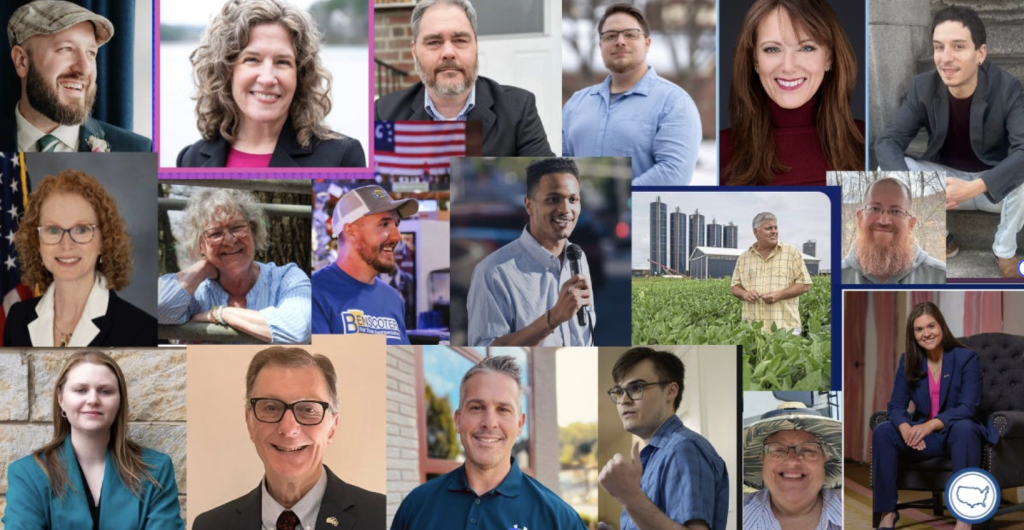
A collage of Pennsylvania state leg candidates who are running in districts that were uncontested in 2024; images taken from candidate websites; credit: author
These are not career politicians – just people who looked at a blood-red district and said – yeah, I’ll take that on. That’s exactly the kind of person who we want running for office.
They don’t have a rolodex of donors or a big political machine behind them. We can’t even say any of them will win this cycle. But they will move numbers, build infrastructure, build name recognition, and knock on doors that haven’t been knocked on in years.
And some of them – like Ron – will shock people, and prove that the district isn’t as lost as everyone assumed.
Even more of them will contribute to gains in congressional districts, and maybe even critical congressional flips.
They’ll all contribute to progress.
Pennsylvania isn’t the only place this is happening. We have First In Line candidates in dozens of states right now, including the states where the US Senate majority will be decided. Every one of them is doing the hard work of showing up in the hardest places.
Conventional wisdom says these races aren’t worth funding.
I disagree; I think they’re some of the smartest places to invest. Maybe you do, too.
Michele Hornish is Co-Founder and Executive Director of Every State Blue, which funds Democratic state legislative candidates in Missouri, Ohio, and Tennessee, and runs First In Line, a national crowdfunding project for candidates running in some of the reddest districts in the country. Learn more about their projects at https://everystateblue.org